DNS trace walks the delegation path for a domain name — from the DNS root, through each zone cut, to the nameservers that claim authority over the name you entered. Each delegation hop is a live query to the authoritative servers listed at that level — not a cached answer from a public recursive resolver.
Enter a domain above to see every hop: which nameservers manage each zone, the glue addresses that let the next hop run, and how each server responded — including timeouts, refusals, and cases where different servers disagree.
How Wirewiki traces DNS delegation
Wirewiki's trace is built for operators who need to see delegation health, not just the final answer a recursive
resolver would return. It follows the same iterative idea as
RFC 1034
section 5.3.3, but makes several choices that differ from dig +trace:
-
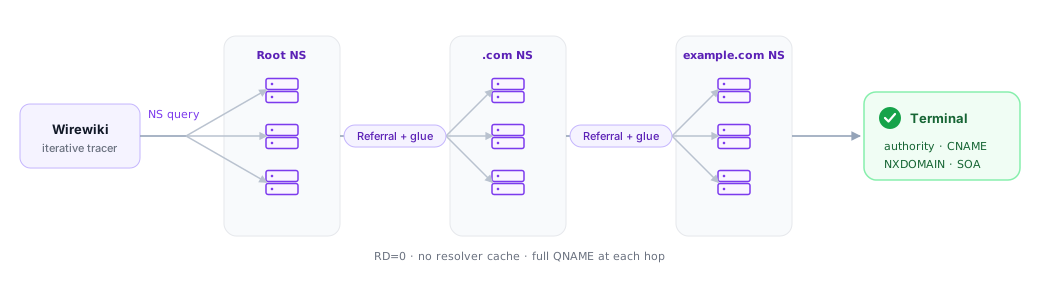
Delegation-focused queries. At every hop Wirewiki sends an
NSquery for your full domain name. That follows the chain of zone cuts (root → TLD → registrable zone → …) rather than tracing a single record type such asA. -
Every nameserver at each level, in parallel. All NS hosts listed for a zone are queried at once.
If they disagree, you get an Inconsistent responses switcher to compare each group's answer side by
side — something a single-path
dig +tracerun will not show. -
Root bootstrap via local resolver. The trace starts from a
.NSquery through Wirewiki's local resolver (not a static hints file on disk). That priming response may be cached briefly by TTL; every hop below the root is always queried fresh. - Glue filled in when missing. If a referral names in-domain nameservers but omits their addresses from the Additional section, Wirewiki resolves those hostnames through the same local resolver so the trace can continue. Strict iterative tracing would stall here.
- Context on every glue IP. Each nameserver address shows ASN, country, anycast hints, and reserved-range labels where applicable — the same enrichment used across Wirewiki's DNS tools.
- No sign-up, no upsell. Wirewiki does not sell DNS hosting or managed DNS; the tool is the product.
What is a DNS trace?
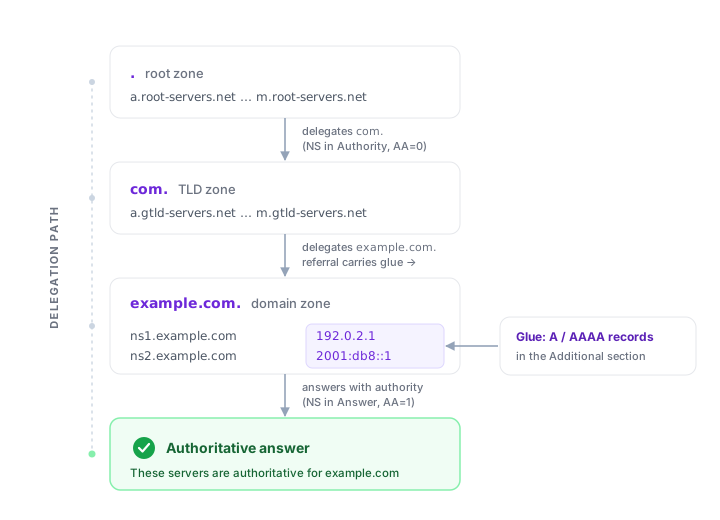
The DNS namespace is split into zones. Each zone is a contiguous subtree of names served by a set
of authoritative nameservers. A delegation (zone cut) is where a parent zone publishes
NS records pointing at the child's nameservers. Resolving any name therefore means walking down that
ladder: ask who serves ., then who serves com., then who serves
example.com., until you reach servers that answer authoritatively for the name you care about.
A DNS trace makes that walk visible. Instead of trusting a recursive resolver to hide the hops, you see each referral, each nameserver list, and each terminal outcome. That is the standard way to answer questions like "is my domain delegated to the right nameservers?", "did the registrar change propagate to the parent zone?", or "which hop is timing out?".
How DNS delegation works
When an authoritative server does not hold the zone for your query name, it returns a referral:
empty Answer section, NS records in the Authority section, the AA (authoritative answer) bit cleared,
and often glue — A or AAAA records in Additional for nameserver
hostnames that live inside the zone being delegated. Glue is bootstrap data so the resolver can open a TCP/UDP
session to the next hop without another round trip.
At the zone that actually contains your name, one of several things happens. The server may return its own
NS set in the Answer section with AA set (Wirewiki labels this authority over the domain). It
may return a CNAME in Answer (the name is an alias — Wirewiki shows the target and stops). It may
return NXDOMAIN (the name does not exist). Or it may return an SOA in Authority with AA
set but no delegation NS — meaning the name falls inside that zone's tree even though this particular query was
for nameserver records.
Reading your trace results
After you trace a domain, the results page is a top-down tree aligned with the delegation path.
-
Root zone card. The first card lists the root nameservers Wirewiki obtained during bootstrap
(home icon, zone label
.). Each row is an NS hostname plus any glue addresses Wirewiki could reach. - Delegation dividers. Between levels you will see a line labelled all servers delegate to, these servers delegate to, or this server delegates to — depending on how many parent servers agreed on the same referral.
-
Zone cards. Each deeper hop is another card named after the referred zone (for example
com.orexample.com.) with the subtitle “These servers manage the … zone”. - Terminal callout. The tree ends in a green or orange banner explaining the outcome: authority claimed, CNAME returned, NXDOMAIN, SOA containment, or server errors (timeout, unreachable, refused).
- Inconsistent responses. When parallel queries to sibling nameservers return different referrals or different terminals, a radio control appears so you can walk each branch separately. This is common during DNS migrations when parent and child zones are briefly out of sync.
Long nameserver lists collapse behind Show more when they exceed the card height — click to expand the full set. Every glue IP is clickable through to Wirewiki's IP and ASN pages where enrichment is available.
Worked example: tracing www.example.com
A typical trace for www.example.com looks like this:
-
Root zone. Wirewiki lists the root nameservers (from priming) and queries each in parallel for
www.example.com NS. They refer to thecom.nameservers — a referral with glue fora.gtld-servers.netand siblings. -
com.zone. Thecom.servers refer toexample.com.'s nameservers. If your registrar still pointscom.at old NS but your DNS host has already updated apex NS, you may see Inconsistent responses here — that is the migration signal. -
example.com.zone. The authoritative servers forexample.comrespond. Most often Wirewiki ends with a green banner: These servers claim authority over www.example.com and lists the zone's apexNSset. If the name is a CNAME, you see the alias target instead and the trace stops.
Registrar NS vs apex NS. The NS set in your registrar's delegation panel must match the
NS records at the zone apex (example.com, not www). Trace shows both sides
of that relationship: parent referrals come from the registrar's glue/NS, the terminal authority card shows what
the zone itself publishes.
Response types you will see
| Outcome | What it means | Typical next step |
|---|---|---|
| Referral (delegation card continues) |
This server is not authoritative for your name; Authority contains NS for a child zone and AA is not set.
|
Follow the referred nameservers downward. |
| Authority (green callout) |
AA is set and the Answer section contains NS for the domain you traced. These are the nameservers the zone publishes for itself.
|
Compare this list to what your registrar or DNS host claims to have published. |
| SOA (green callout) |
AA is set, Authority holds SOA, and the banner names the zone that contains your domain. The server is authoritative for a parent of your name but returned no NS in Answer for this query.
|
Normal for some qnames; trace a child name or check NS at the zone apex separately. |
| CNAME (green callout) |
Answer contains a CNAME. Wirewiki shows the alias target and stops.
|
Run a new trace on the canonical name if you need to continue past the alias. |
| NXDOMAIN (orange callout) | The server claims authority but says the name does not exist. | Confirm spelling; check whether the name should exist in this zone; look for a stale cut above. |
| Error (timeout / unreachable / refused / SERVFAIL) | The nameserver never returned a usable response, or returned SERVFAIL. | Test reachability to that host and port 53; fix firewall, lame delegation, or zone/DNSSEC errors on the server. |
Wirewiki vs dig +trace
dig +trace is the usual command-line reference for tracing DNS. Wirewiki is complementary: it is
built for delegation troubleshooting at scale, not for reproducing a single resolver's cached path.
| Aspect | dig +trace |
Wirewiki DNS trace |
|---|---|---|
| Default question |
Traces whatever QTYPE you pass (often A)
|
NS for your full domain at every hop
|
| Nameservers queried | One server chosen from each referral (implementation-dependent) | All NS hosts at each level, in parallel |
| Disagreeing servers | You see one path per run | Branch switcher when responses diverge |
| Cache |
No cache inside +trace
|
Live queries at each delegation hop; root priming may be cached by TTL |
| Root bootstrap | Static root hints file |
Live . NS query via local resolver
|
| Missing glue | May stall or resolve NS names separately | Resolves missing in-domain glue via local resolver |
| CNAME handling | Prints CNAME and stops | Same — shows CNAME, does not chase |
| Enrichment | Raw DNS wire format | ASN, country, provider hints on glue IPs |
Common problems and what to check
| What you see | Likely cause | What to verify |
|---|---|---|
| Trace stops before the expected zone | Missing in-domain glue in the referral, or nameserver IPs unreachable | Additional section of the previous hop; firewall path to port 53 |
| Inconsistent responses between branches | Parent and child NS sets out of sync during a migration | Registrar glue vs child apex NS; TTL not expired everywhere |
| Orange NXDOMAIN at the zone you control | Name not in zone file, or wrong zone cut above | Zone file / DNS panel; whether the name should be a CNAME elsewhere |
| Errors on every server in a card | Lame delegation, network block, or server down | Ping/traceroute to NS host; TCP/UDP 53 from your network |
| Authority NS list ≠ registrar NS | Stale parent delegation or wrong child apex |
Registrar delegation vs DNS host apex NS records
|
| CNAME at the name you traced | Expected for aliases; trace continues at the target | Re-run trace on the canonical name |
Trace DNS delegation from the command line
dig +trace example.comdig +trace example.com NSnslookup -debug example.com
dig +trace uses your system's resolver for glue resolution in some cases and follows one server per
hop. For the parallel, glue-enriched view Wirewiki shows, use the trace above or share a results URL with a
colleague.
Related Wirewiki tools
DNS trace shows who should answer for a name. These tools answer the next questions once delegation looks correct:
- DNS lookup — all common record types from the authoritative nameservers in one view.
- DNS propagation — compare answers from public and local resolvers after you change a record.
- NS lookup — focus on the nameserver set and glue for a zone apex.
- DNS history — see how published records changed over time for archived domains.
-
SPF lookup — walks
includechains in TXT records (a different kind of DNS tree).
Frequently asked questions
Is DNS trace the same as DNS propagation check?
No. Propagation compares final answers from many recursive resolvers around the world. Trace walks the authoritative delegation chain from the root downward and shows each zone's nameservers. Use trace to verify delegation; use propagation to see whether resolvers have picked up a record change.
Why does Wirewiki query NS instead of A?
An NS query at each hop follows zone cuts directly. An A trace still hits referrals on
the way down, but terminal shapes differ (you may end on an address record instead of the zone's nameserver
list). Wirewiki optimises for "who is authoritative for this name?" — the question operators ask when
debugging delegation.
What does “Inconsistent responses” mean?
Wirewiki queried every nameserver at a zone level in parallel and got materially different answers — different referral targets, different authority claims, or a mix of success and timeout. That usually indicates partial propagation, a mistake in one nameserver's zone file, or a lame server still listed in NS.
Why can the trace continue when glue is missing?
Strict iterative resolution requires glue in the referral when the nameserver hostname lies inside the child
zone. Wirewiki resolves those hostnames through its local recursive resolver so you can still see the next hop.
That matches operational reality but is not identical to a purist dig +trace run with no helper
resolver.
Does trace follow CNAME chains?
No. If a server returns a CNAME, Wirewiki displays it and stops — the same behaviour as
dig +trace. Start a new trace on the canonical target if you need to continue.
Can I trace a subdomain separately from the apex?
Yes. Enter any domain name — www.example.com, mail.example.com, or
example.com. The walk still passes through the same parent zones; only the terminal outcome may
differ.
How is this different from traceroute?
Traceroute follows IP routing hops (ICMP/UDP) to a host. DNS trace follows DNS delegation — which nameserver refers you to which zone. A routing problem and a DNS problem can both make a site unreachable; they require different tools.
Are results cached?
Each trace issues live queries to the authoritative nameservers at every delegation hop. Wirewiki may cache the root priming response (the list of root servers) for up to its TTL; everything below the root is always fetched fresh. Re-run a trace after you change delegation to see the update. Authoritative servers may still serve their own cached negative answers within TTL — that is normal DNS behaviour on their side.
Does Wirewiki validate DNSSEC?
Queries include the DNSSEC OK (DO) bit so signed responses can carry signatures, but Wirewiki does not run a full chain-of-trust validation. A SERVFAIL from a validating-aware server may still appear as an error on the trace even when unsigned delegation looks fine.